Pocket Option for Beginners
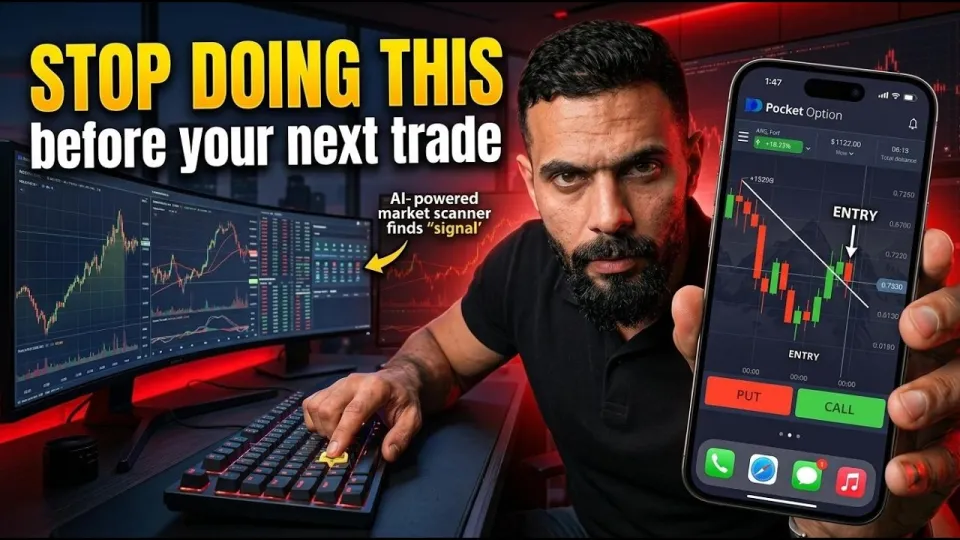
Video: Pocket Option for BEGINNERS! 5 USEFUL RULES!
· based on the channel Trader Sam
Key takeaways
- A beginner account should risk no more than 1–2% of the balance on a single binary option trade.
- Pocket Option offers expiry times from 5 seconds up to several hours, and short expiries behave very differently from 15–30 minute ones.
- The minimum trade on Pocket Option is $1, which lets a new trader test a setup 50 times on a $50 demo balance.
- The promo code SAM11 advertised in the Trader Sam video adds a 60% bonus to a deposit.
- One setup, one asset and one expiry per session is the core rule that separates a plan from gambling.
Pocket Option for beginners comes down to five rules: cap every trade at 1–2% of the balance, pick an expiry that matches the setup instead of the shortest timer, trade one setup per session, spend the first weeks on a demo account, and log every trade in writing. Those rules do not predict the market, but they keep a new trader alive long enough to learn how the platform and the payout structure actually work. Trader Sam's beginner breakdown covers the same ground, and the free bot linked from it — the free trading bot on Telegram — is best treated as a testing tool, not a shortcut.
What Pocket Option actually is and what a beginner signs up for
Pocket Option is a binary options broker where a trade is a bet on direction, not a position you can hold. You choose an asset (currency pairs, gold, crypto, stock CFDs, and the OTC pairs the platform generates itself), pick an expiry, and either buy the option or use the Instant / Turbo modes where the trade starts immediately. The payout is quoted up front, usually in the 50–90% range depending on the asset and the time of day, and a losing trade costs the full stake. That single mechanic — fixed risk, fixed reward, no partial exits — is what separates binary trading from spot trading and what makes position sizing the most important skill a beginner can learn.
The account types are straightforward: a demo account with virtual funds, and a live account funded from around $5–$10 depending on the payment method. The minimum trade size is $1, which is genuinely useful for a beginner because it makes a 50-trade sample affordable. Withdrawals are processed back to the same payment method, and the platform's bonus codes — like the SAM11 code that adds 60% to a deposit — lock part of the balance into trading volume requirements, so a bonus is not free money and should be skipped until the basics are solid.
The five rules that keep a first account alive
Rule 1 — size every trade at 1–2% of the balance. On a $100 account that is $1–$2 per trade. With a 70% payout you need to win roughly 59% of trades just to break even, so a 10% stake turns three losses in a row into a 30% drawdown. Small size buys you the sample you need to judge whether a setup works.
Rule 2 — match the expiry to the setup, not to boredom. Pocket Option offers expiries from 5 seconds to several hours. A 30-second trade on a 1-minute chart is noise; a 15-minute expiry on a 5-minute chart with a clear level gives the idea room to play out. Beginners should start with 5–15 minute expiries on major pairs during the London and New York sessions and leave the OTC assets alone until they understand how the payout behaves outside market hours.
Rule 3 — trade one setup, one asset, one expiry per session. Pick a single pattern — a bounce from a support level confirmed by a moving average, for example — and take only that. Ten different indicators on one chart produce contradictory signals and no data you can learn from.
Rule 4 — spend the first two to four weeks on demo. The demo balance is virtual, but the chart, the payout quote and the platform mechanics are identical. Use it to learn where the payout is displayed, how the trade confirmation works, and how long a withdrawal request takes to clear.
Rule 5 — write down every trade. Asset, time, expiry, setup, result, and one sentence on why you entered. Twenty logged trades tell you more about your edge than twenty hours of watching other people trade.
Beginner strategy and indicators that fit a fixed-expiry format
A workable beginner strategy on Pocket Option needs a trend filter and a trigger, nothing more. A 50-period EMA on a 5-minute chart tells you the direction; a stochastic or RSI reading below 20 in an uptrend (or above 80 in a downtrend) tells you when price is stretched and likely to snap back. Enter on the close of the candle that confirms the reversal, with an expiry of two to three candles — 10 to 15 minutes on a 5-minute chart. Support and resistance levels drawn by hand beat any indicator pack, because they show where other traders have already placed orders.
Avoid stacking five indicators that all measure the same momentum. Two tools with different jobs — one trend, one timing — is the maximum a beginner can process in real time. Price action on major pairs such as EUR/USD during the European session is the most forgiving place to start, because spreads are tight and the payout is usually at its highest.
Questions beginners ask before their first deposit
The recurring doubts are always the same: how much money do I need, does a bot replace learning, and is a bonus worth it. A live account can be opened with a few dollars, and there is no rule that says a beginner must deposit more than $50 — the goal of the first month is information, not income. Trading bots, including the AI-style bots promoted in the community around Trader Sam's channel, execute rules faster than a human but cannot invent an edge; they amplify whatever strategy you feed them, including a bad one. Bonus codes that add 60% to a deposit usually come with volume conditions, so the extra balance is only useful if you were going to trade that volume anyway.
On the platform side, the practical questions are about the app: Pocket Option's mobile app mirrors the web terminal, supports the same assets and expiries, and is fine for placing a trade you have already planned — but planning a trade on a phone screen, with notifications arriving, is how beginners break their own rules. Plan on the desktop chart, execute on the phone if you must.
Where the Trader Sam resources fit
Trader Sam's beginner video is a short rules-based walkthrough, and the channel's supporting links are worth knowing before you click them. The free bot is delivered through Telegram, the community group is where questions get answered, and the registration link carries the SAM11 promo code with its 60% deposit bonus.
- Free trading bot on Telegram: https://t.me/trading_Sams_bot?start=yt_102026_promo
- Trader Sam community group on Telegram: https://t.me/+SplhMM86UZUwYmIy
- Registration with the SAM11 code (+60% deposit bonus): https://trader-sam.pro/register/
Treat the bot as a way to backtest a rule set on small stakes, not as an account manager. Any tool that trades for you still needs the five rules above applied to its output.
Conclusion
Pocket Option rewards discipline more than prediction: fixed stakes of 1–2%, expiries matched to the chart, one setup per session, a demo period measured in weeks, and a written log are what turn a beginner account into a learning curve instead of a one-week story. The platform's $1 minimum and demo mode make that process cheap, and the 50–90% payout structure makes it obvious why oversized trades are fatal. Trader Sam's beginner breakdown is a useful starting point for the rule set, and the free bot from the video is the natural next step once your own rules are written down and tested.
Source: Pocket Option for BEGINNERS! 5 USEFUL RULES! · Markdown version
Questions & answers
How much money do I need to start trading on Pocket Option?
A live account can be funded with a small amount, and the minimum trade is $1, so $50–$100 is enough to trade at a 1–2% stake. The first month should be treated as paid education, not as income. Starting on the demo account costs nothing and teaches the same platform mechanics.
Are 30-second trades a good idea for beginners?
No. Very short expiries turn the trade into a coin flip on noise, and the payout is usually no better than on longer expiries. Beginners do better with 5–15 minute expiries on 5-minute charts, where a level or a trend has time to play out.
Can a trading bot replace learning the strategy?
A bot only executes rules faster than a human; it cannot create an edge that is not in the rules. Use one to test a written setup on small stakes, and check its results against your own manual trades. If the manual version does not work, the automated one will not either.
Is the 60% deposit bonus with the SAM11 code worth taking?
Only if you already plan to trade the volume the bonus requires, because bonus funds are typically locked until a turnover condition is met. For a first deposit, a clean balance without conditions is easier to manage and to withdraw. Read the bonus terms before applying any promo code.